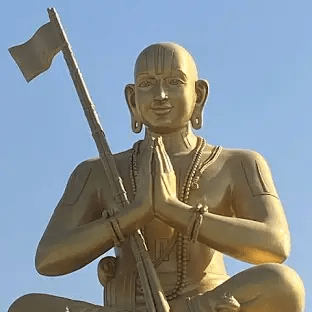
This short essay was written as coursework with the Oxford Centre for Hindu Studies and considers how Ramanujacharya is able to reconcile an Advaitic form of Vedanta with a devotional theology that reveres a personal Deity?
Ramanujacharya (or Ramanuja) was a 11th-12th century (traditional dates: circa 1017–1137 CE) exponent of the visishtadvaita philosophy which can be considered as non-dualism of qualified Brahman. Unlike Shankacharya (or Shankara) who maintained that man is identical with Brahman, Ramanujacharya stated that man is a ray or spark of God; and Brahman or Īṣvara or Narayana or God is in inseparable relationship with both nature and individual souls (Ramakrishnananda, 2022). This essay examines how the idea of Advaita (non-dualism) is not pursued in Ramanujacharya’s thought to the same extent it is in Shankacharya’s teaching. This is then used as a basis to demonstrate how visishtadvaita supports the intense devotion within the teachings of Ramanuja and his followers.
To understand how Ramanuja’s system of visishtadvaita does not pursue the concept of non-dualism to the extent that Shankara’s teaching does, it is useful to examine the criticisms of Shankara’s work put forward by Ramanuja. In Shankara’s school of Advaita Vedanta, he argues for the common conception of Maya, the existence non-existence entity which creates an illusion, therefore creating something that does not actually exist (Isayeva, 2016). To Shankara, this illusory Maya and the power of Brahman causes the jiva to experience duality, presenting reality to the human mind as divided into subject and object. Jiva or the individual soul is only relatively real – only lasting as long as it remains deluded by Avidya or ignorance (Kumar, 2023).
Ramanuja rejects this philosophy as its belief in non-distinction reduces the status of personal Deity which was unacceptable to him as a Sri Vaishnavite and a bhakta (Adidevananda, 2022). For Ramanuja, Maya is real insofar as it is the real power of God by which He creates the world. This creation of objects is known as VichitrathasargakariSakti. Maya also stands for the creative Praktri, characterises Brahman and is real. Ramanuja rejects Shankara’s assertion that Maya and Avidya (ignorance) are the same (Singh, 1991).
Ramanuja was also the first of the Vedanta philosophers to make the foundation of his philosophy, the identification of a personal Deity with the Brahman or Absolute Reality, of both the Upanishads and the Vedanta-sutras. Central to understanding how Ramanuja is able to reconcile an Advaitic form of Vedanta with a devotional theology that reveres a personal Deity, is the understanding of his system of non-dualism of qualified Brahman. Soul and matter are the qualifications of the ultimate reality Brahman. Ramanuja rejects the nirguna (non-qualified) concept of Brahman but accepts the saguna (qualified) concept (Baruah, 2017). The Nirguna concept is that Brahman is beyond space and time, is formless and present everywhere. Brahman is the formless substrate Consciousness with no attributes, that causes all things (Taft, 2014). However, in his commentary on the Vedanta-sutras, Ramanuja argues that Brahman “is not destitute of attributes but rather endowed with all imaginable auspicious qualities. It is not intelligence as Shankara maintains but intelligence is its chief attribute” (Badarayana, Rangacharya and Aiyangar, 2017).
Ramanuja’s philosophy like Shankara’s philosophy holds that Brahman is the Ultimate Reality, and includes everything but unlike Shankara, Ramanuja also believes that Brahman has gunas, or qualities, and therefore is Saguna. Ramanuja’s Brahman is Saguna Brahman, that is “Ultimate Reality assigned with attributes” (Rodrigues, 2023). It is therefore noteworthy that in Ramanuja’s system, it is Brahman that is qualified and not the concept of non-dualism.
Ramanuja’s Brahman is presented as real God, Narayana (Vishnu) or Ishvara. His philosophy can be seen as theistic Vedanta in opposition to Shankara’s absolutistic Vedanta (Baruah, 2017). Narayana is the absolute form of Brahman, but Brahman is transformed into the physical universe and into the individual souls which are aspects of Brahman but not a full manifestation of Brahman. So, whilst the Self and world are Brahman, they are different from Narayana and also from each other. In the Sri-Vaisnava tradition, atman is not equal, or the same as Brahman but is a mode or aspect of Brahman, totally dependent upon Narayana (Rodrigues, 2023).
Ramanuja illustrates this with reference to the relationship between soul, mind, intellect and material form which are different aspects of a single being. Ramanuja shows that when we refer to most things separable from us (such as my home) as separate from us, there are two types of cases in which we refer to things as inseparable that are separable in principle, namely those which relate to substance and attributes, and secondly, body and soul (Sundararajan, 2007). If we believe that the soul and the body are separate entities, then our sense of “I” must originate from the soul, as without it, body is just matter. The distinction between man and woman is down to physical anatomy and the body. But we identify the soul with that body when we declare “I am a woman.” Ramanuja also uses the concepts of Praktri and purusha to describe the relationship between the body and soul. He asserts that the physical body is connected to primordial matter (Praktri) but is also ruled by the sentient soul (purusha) with the former always subservient to the latter (Whitehead, 2019). It is also important to note that Ramanuja asserts in his commentary on the Gita that when freed from prakriti (matter), the atman is equal to both others and the Lord (Badarayana, Rangacharya and Aiyangar, 2017). This is central in identifying Ramanuja as a true proponent of Advaita and its central tenet of non-dualism.
Ramanuja emphasises these inseparable relationships between soul, body and intellect which he terms aprithak-siddhi, or inseparability (Tapasyananda, 2023). Ramanuja then goes on to extend the body-soul mode of relationship to Brahman, and specifically jagat and jiva. Although Ishvara is the absolute form of Brahman, Ramanuja’s system of thought maintains a subtle difference between them. Ishvara is the substantive part of Brahman, whilst the secondary attributes jivas (soul) and jagat (the universe) are modes. Ramanuja also describes auspicious attributes, kalyana gunas which are the primary attributes of Brahman which unlike secondary attributes are eternally manifest. However, whilst secondary attributes jivas and jagat are only manifest when the world is differentiated by form, they continue to exist in subtle form within the supreme Deity, even when the world is not manifest (Srinivasachari, 2010).
With this understanding of Ramanuja’s system and thought in mind, it is possible to show how and why the visishtadvaita supports the pronounced level of devotion found within the writings of Ramanuja and his followers, many of whom further developed visishtadvaita. In Ramanuja’s teachings, when a being achieves moksa (liberation), the individual is no longer caught up or distracted by maya. Unlike Sankara’s philosophy which maintains that liberation is achieved through Self-realisation and knowledge of non-difference and unity between atman and Brahman, Ramanuja believes that it is the power of the Lord, not the individual that liberates an individual. This liberation is achieved through the “descent of his grace, the goddess Sri” who is both merciful and gracious (Adidevananda, 2022). Sri, or Lakshmi is central for Sri Vaisnavas and in harmony with the non-dual qualified Brahman, Lakshmi or Sri, is considered both identical with yet different from her consort Narayana.
For Ramanuja, bhakti (loving devotion) and prapatti (absolute surrender) are the main ways in which an individual achieves liberation (Nayar, 1988). Although Shankara was not overtly critical of theistic devotional practices, he only accepts them as a lower level of truth (Salmond, 1995), bhakti as a route to liberation (moksha) only holds philosophical coherence in Advaita in the context of Ramanuja’s non-dualistic qualified Brahman. In Shankara’s absolute non-dualism there is no difference between the deity, atman and Brahman – all are Brahman. Devotional practices are based on the separation of devotee from object of devotion and devotion itself is viewed as a stream of love that crosses this ontological separation between devotee and deity (Salmond, 1995). Therefore, Shankara’s absolute non-duality of soul and God appears to exclude devotionalism or relegate it to a lower level of reality. Conversely, for Ramanuja, Brahman is not a formless entity, but a Supreme Person qualified by matter and form and so loving devotion towards this supreme Deity as a primary path to liberation is a natural consequence of this school of thought. It is exemplified in the intense outpouring of love of the Tamil Alvars whose devotional poetry and practices were Ramanuja’s spiritual heritage (Syndor, 2014).
Although Ramanuja’s philosophical system supports devotionalism as the highest form of religious realisation for man takes the form of love of God; for Ramanuja, this love (although characterised by passion and emotion) is not merely an emotional state. Devotion also requires man to retain his distinct identity in order that he is able to experience this union (Bowes, 2021). Thus, the devotion is not just compatible with Ramanuja’s non-dualistic qualified Brahman but is inherently dependent on it. This distinct identity is also necessary for receiving mercy and liberation.
Another theme in Ramanuja’s philosophical system is the concept of prapatti (ultimate surrender) which is also vital for liberation and is linked to the loving devotion of Bhakti. There are two kinds of bhakti in Ramanuja’s philosophy, para bhakti and parama bhakti. Disinterested action (niskama karma) is necessary for awakening higher knowledge. This is also known as parajnana, because it creates a desire for direct knowledge of God. That experience of God fails to satisfy the spiritual desire of the devotee which in turn creates continual feelings of union with God. This is known as parama bhakti. The parama bhakti creates an intense feeling of prapatti (surrender to God) (Borah and Das, 2020). The idea of prapatti as a path to liberation depends on Ramanuja’s theory of non-dual qualified Brahman since the distinct identity of the aspirant from Narayana as the absolute form of Brahman allows for both the unquenched desire and the feelings of union which lead to prapatti. Post-Ramanuja teachers, particularly Vedantadesika takes Ramanuja’s often ambivalent comments in relation to prapatti and argues that Ramanuja taught it as an independent means to moksha. But even if prapatti were an independent means, the non-dual qualified Brahman and the different attributes of Narayana and the aspirant make the surrender more coherent. Surrender means to cease resisting an outside force or another person (Freimann and Mayseless, 2021). If Ramanuja had pursued Advaita and non-dualism to the same extent as Shankara where all is Brahman with no distinction, then the appearance of an outside force or other person would be illusory or of a lower level of truth. In that context, the idea of prapatti would not be of such importance or a key route to liberation.
In conclusion, although Shankara and Ramanuja are both non-dualists, they differ in that for the former Shankara, this non-dualism is absolute whereas Ramanuja qualifies the attributes of Brahman. Although a full analysis of the rich and complex philosophy of Ramanuja and Visishtadvaita philosophy is not possible in the scope of this essay, key points show how Ramanuja’s interpretation of non-dualism allows for devotion to a personal deity.
Ramanuja sees Brahman as having attributes or gunas rather than being formless as Shankara views Brahman. Brahman is transformed into both the physical universe and individual souls or jivas. Unlike Shankara who sees atman as being identical with Brahman, for Ramanuja, atman is as aspect of Brahman. Additionally, the Deity Narayana is the absolute form of Brahman and atman is dependent on Narayana but is not identical with it. Although both Narayana and atman and individual jivas are aspects of Brahman, reflecting the non-dualism of Ramanuja’s form of Vedanta, this ontological separation between them allows for the intense devotional practices advocated by Ramanuja and his followers. Bhakti and prapatti (devotion and surrender) are the means by which liberation is achieved, due to the mercy of Narayana. This belief system has had a profound influence on Indian philosophy and religious practice and the beliefs of most Hindus today reflects the thought of Ramanuja who was primarily a bhakta; and it was from this position that his philosophy developed.
REFERENCES
Adidevananda, S., 2022. Sri Ramanuja Gita Bhasya. Sri Ramakrishna Math.
Badarayana, B., Rangacharya, M. and Aiyangar, V., 2017. The Vedanta-sutras, With the Sri-bhashya of Ramanujacharya. Andesite Press.
Baruah, G., 2017. The history of the Vedanta. Cinnamara College Publication Cinnamara, Jorhat-8, Assam, 4.
Borah, B. and Das, D., 2020. Bhakti and Prapatti as a means to liberation: Ramanujacharya. International Journal of Management (IJM), 11(11).
Bowes, P., 2021. The Hindu religious tradition: A philosophical approach. Routledge.
Freimann, A. and Mayseless, O., 2021. Surrender to another person: The case of a spiritual master. Journal of Humanistic Psychology, p.0022167820975636.
Isayeva, N., 2016. Shankara and Indian philosophy. State University of New York Press.
Kumar, M., 2023. The Advaita philosophy of Sri Sankaraacharya: A critical analysis. International Journal of Multidisciplinary Trends; 5(1): 21-24.
Nayar, N., 1988. The concept of prapatti in Ramanuja’s “Gītābhāsya”. Journal of South Asian Literature, 23(2), pp.111-132.
Ramakrishnananda, S., 2022. Life of Sri Ramanuja. Sri Ramakrishna Math.
Rodrigues, H.P., 2023. Introducing Hinduism. Taylor & Francis.
Salmond, N., 1995. Advaita and Imagery: Sankara on Devotional Objects, and as Himself an Object of Devotion. Arc: The Journal of the School of Religious Studies, 23, pp.89-105.
Singh, B.N., 1991. Dictionary of Indian Philosophical Concepts. Asha Prakshan: Nagawa.
Srinivasachari, P.N., 2010. The Philosophy of Visistadvaita. Sri Ramakrishna Math.
Sundararajan, K.R., 2007. Self, Consciousness and Self-Consciousness in Rāmānuja’s Vedānta. Journal of Indian Philosophy and Religion, 12, pp.75-89.
Sydnor, J.P., 2014. Jaimini, Shankara, and the Alvars: Ramanuja’s Enduring Synthesis: Journal of Vaishnava Studies. Journal of Vaishnava Studies, 22(2), pp.9-26.
Taft, M.W., 2014. Nondualism: A brief history of a timeless concept. Berkeley: Cephalopod Rex.
Tapasyananda, S., 2023. Sri Ramanuja His Life Religion and Philosophy. Sri Ramakrishna Math.
Whitehead, J., 2019. An understanding of Maya: the philosophies of Sankara, Ramanuja and Madhva (Doctoral dissertation, University of Pretoria).
 Mental Health Nursing
Leave a comment